Published
- 4 min read
How to Move a Trampoline Without Taking It Apart
How to Move a Trampoline Without Taking It Apart
Once you have finally finished assembling your 15-foot backyard trampoline, the last thing you ever want to do is take it apart. However, there are inevitably times when you need to move it. Perhaps the grass underneath is dying and needs sunlight, perhaps you are doing some landscaping, or maybe you just need to mow the lawn.
Moving a fully assembled trampoline is not as simple as just grabbing an edge and dragging it. A standard 14 or 15-foot trampoline weighs between 150 and 250 pounds. Furthermore, dragging it across the lawn puts immense horizontal stress on the U-shaped legs. If a leg catches on a root or a divot, the hollow steel frame will bend or snap, permanently ruining the structure.
As a professional installer, I have moved hundreds of fully assembled trampolines. In this guide, I will share the three safest methods for relocating your bounce zone without damaging the frame, your grass, or your back.
Method 1: The “Many Hands” Lift (The Safest Manual Way)
If you have a group of adults available, a coordinated manual lift is the safest way to move the structure.
- The Team: You need a minimum of 4 adults, but ideally one person for every U-shaped leg (usually 6 people).
- The Technique:
- Station one person at each leg.
- Everyone must grip the curved top rail beneath the safety pad, NOT the vertical enclosure poles.
- On the count of three, everyone lifts the trampoline simultaneously to waist height.
- Walk slowly and synchronously to the new location and set it down gently.
- The Warning: If you try to do this with only two people, the middle of the frame will bow under its own weight and bend the top rails.
Method 2: The “Trampoline Wheels” Upgrade (The Solo Method)
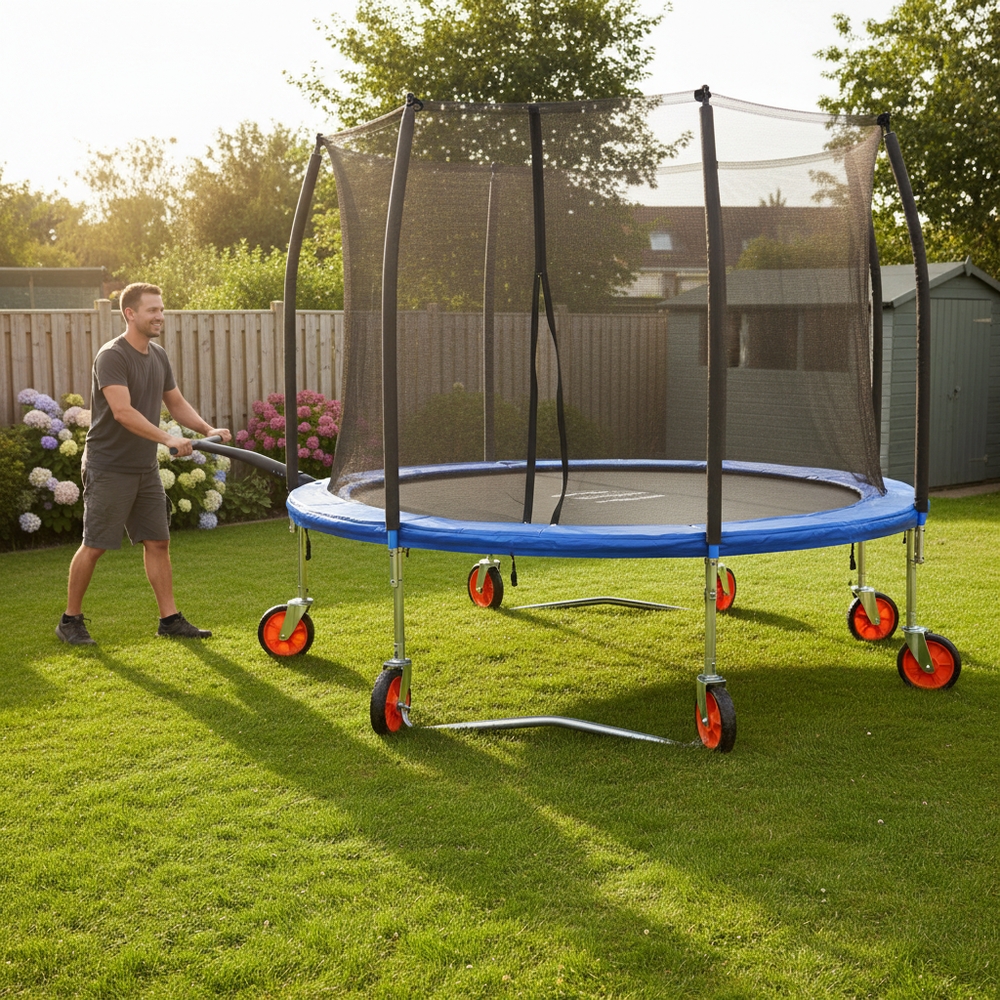
If you need to move the trampoline frequently (e.g., every week to mow the lawn), relying on neighbors isn’t practical. The ultimate solution is investing in a set of specialized trampoline wheels.
- How they work: These are heavy-duty caster wheels attached to a steel bracket that slides under the U-shaped legs of the trampoline. When you push down on the handle, the wheels act as a lever, lifting the leg off the ground.
- The Technique: You attach a wheel to every leg. Once all legs are lifted, a single person can easily roll a 250lb trampoline across the grass like a giant shopping cart.
- Why it’s essential: It completely eliminates the horizontal drag-stress on the frame.
- Affiliate Pick: Heavy Duty Trampoline Mover Wheels (Set of 4)
Method 3: The “Tractor Pull” (For Large Properties)
If you need to move the trampoline a significant distance across a large property (e.g., to a different field) and you have a riding lawnmower or an ATV, you can tow it—but you must do it carefully.
- The Gear: You need a heavy-duty tow strap and a piece of plywood.
- The Technique:
- Wrap the tow strap around the base of a U-shaped leg (where it touches the ground), not the top rail.
- Place a large piece of slick plywood or a heavy-duty moving blanket under the leg you are towing. This acts as a “sled” and prevents the leg from digging into the dirt.
- Tow the trampoline at a walking pace. Keep a spotter walking alongside to ensure the trailing legs aren’t catching on anything.
- Affiliate Pick: Heavy Duty Ratchet Tie Down Straps
Important Considerations Before Moving
1. Remove the Anchors First! This sounds obvious, but it is the #1 mistake people make. Trying to move a trampoline that is still corkscrewed into the ground will instantly tear the straps or bend the frame. Double-check every leg before lifting.
2. Check the Enclosure Clearance If you are moving the trampoline across the yard, map your route. Look up. Are there low-hanging tree branches or power lines? An enclosure net is usually 9 feet tall. You may need to temporarily drop the top ring of the net if you have to pass under an obstacle.
Conclusion
Moving a fully assembled trampoline requires strategy, not just brute force. By enlisting enough help for a synchronized lift, or better yet, investing in a set of specialized trampoline wheels from Amazon, you can easily relocate your bounce zone. Protect your lawn, protect your back, and most importantly, protect the delicate structural integrity of your trampoline’s steel frame.