Published
- 5 min read
In-Ground vs. Above-Ground Trampolines: The Ultimate Comparison
In-Ground vs. Above-Ground Trampolines: The Ultimate Comparison
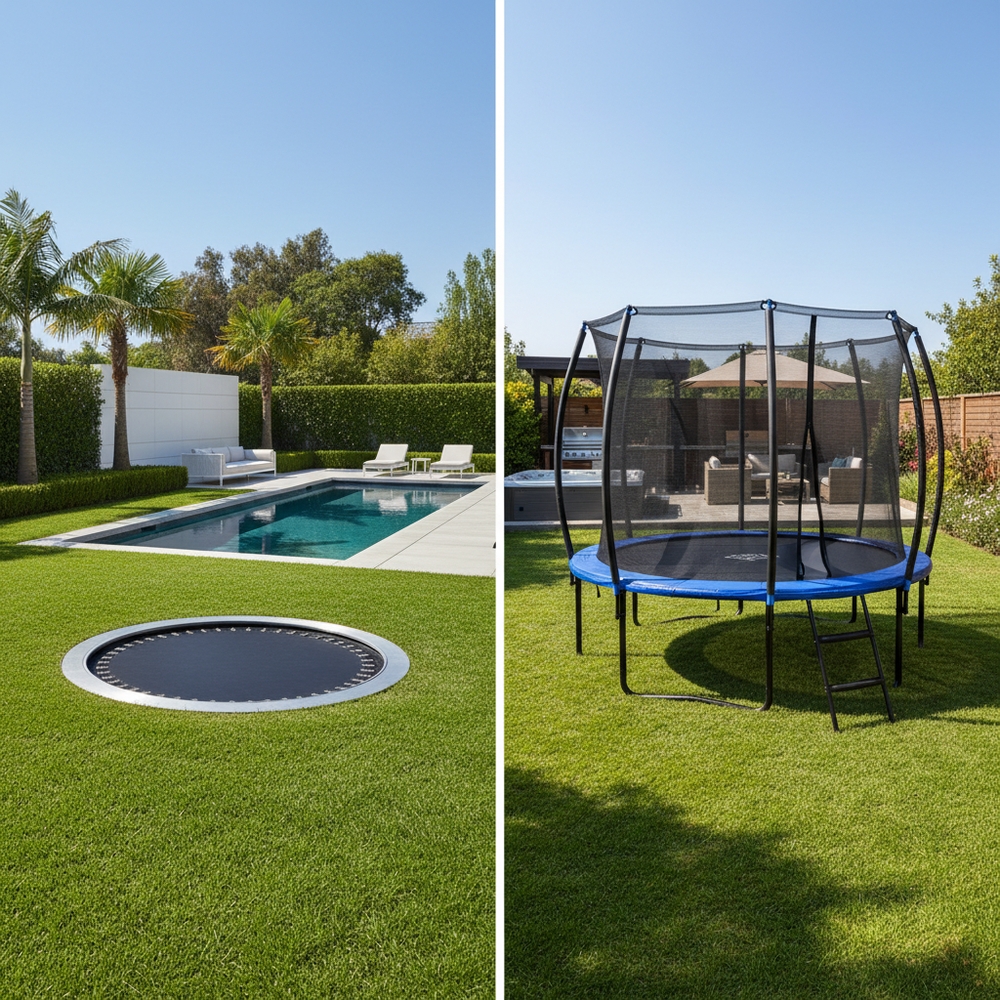
When planning the ultimate backyard, the trampoline is often the centerpiece of family fun. But for many homeowners, the visual of a massive 15-foot steel and mesh structure dominating the lawn is an eyesore. This aesthetic clash has led to the massive rise in popularity of In-Ground Trampolines.
By sinking the trampoline flush with the grass, you remove the visual obstruction and seamlessly integrate the bounce zone into your landscaping. But is an in-ground trampoline actually better? Does it bounce the same? Is it safer?
As a backyard design and safety expert, I help clients navigate this exact dilemma every week. In this comprehensive guide, I will break down the pros, cons, costs, and safety factors of In-Ground vs. Above-Ground trampolines to help you make the best decision for your family and your yard.
1. Aesthetic Integration and Landscaping
This is the primary reason people choose to go in-ground.
- In-Ground (The Winner): A sunken trampoline is virtually invisible from across the yard. It preserves the sightlines of your landscaping and allows the garden to remain the focal point.
- Above-Ground: Standard trampolines are bulky. They block views and cast a large, permanent shadow that can kill the grass underneath them.
- The Compromise: If you must stay above-ground, look for brands with sleek, all-black frames and nets (like Springfree or Acon) that blend into the background better than traditional blue or green pads.
2. The Safety Factor: Fact vs. Fiction
There is a massive misconception that in-ground trampolines are inherently safer because you can’t “fall off” a high edge. This is only partially true.
- Fall Height (In-Ground Wins): If a jumper bounces off the edge of an in-ground trampoline, they fall 0 feet to the grass. On an above-ground model, they fall 3 feet to the ground (which is why enclosure nets are mandatory).
- The “Half-On, Half-Off” Danger (Above-Ground Wins): The biggest danger of an in-ground trampoline without a net is that a jumper can land with one foot on the bouncy mat and one foot on the solid ground, resulting in severe ankle and knee fractures. Therefore, even in-ground trampolines require an enclosure net for maximum safety.
- Wildlife: In-ground pits can become traps for frogs, mice, and snakes if not properly sealed.
3. The Quality of the Bounce
This is where physics comes into play. A trampoline needs air displacement to bounce.
- Above-Ground (The Winner): Because the mat is suspended in open air, the air beneath the mat escapes freely when you jump. This results in a deep, high, unrestricted bounce.
- In-Ground: When you jump on a sunken trampoline, the mat pushes air down into the pit. If that air cannot escape quickly enough, it creates a “vacuum” effect, stiffening the mat and reducing the height of the bounce.
- The Fix: If you buy an in-ground kit, you must ensure it features “Vented Safety Pads” that allow the trapped air to escape through the sides.
- Affiliate Pick: In-Ground Vented Trampoline Safety Pad Replacement
4. Cost and Installation
Here is the brutal reality: an in-ground trampoline is a major landscaping project.
- Above-Ground: You buy the box, spend 2 hours assembling it with a friend, and you are bouncing. Total cost: $400 - $2,500.
- In-Ground: You cannot just bury a standard above-ground trampoline. The soil will rust the frame, and the retaining wall will collapse. You must buy a specialized “In-Ground Kit” with a reinforced retaining wall. Then, you must excavate 3-4 feet of dirt, install a drainage system (or risk a flooded pit), build the wall, and assemble the mat. Total cost (including excavation labor): $2,000 - $5,000+.
5. The Best Kits on Amazon
If you decide to take the plunge, do not try to DIY a standard frame. Use a purpose-built in-ground system.
The Best In-Ground Kit: Avyna Pro-Line In-Ground Trampoline
Avyna is a Dutch company famous for their commercial-grade in-ground systems.
- Why it wins: It comes with a built-in heavy-duty retaining wall structure that prevents soil from collapsing into the pit. It also features a highly breathable mat to eliminate the “vacuum” effect.
- Get it on Amazon: Avyna Pro-Line In-Ground Trampoline Kit
The Best Above-Ground Alternative: Zupapa 15ft
If the excavation costs scared you off, stick with a premium above-ground model.
- Why it wins: Hot-dip galvanized frame prevents rust, and the high-density net ensures nobody falls off.
- Get it on Amazon: Zupapa 15ft Heavy Duty Trampoline
Conclusion
The choice between in-ground and above-ground comes down to budget and aesthetics. If you have the budget for excavation and drainage, an in-ground trampoline provides unparalleled visual integration with your garden. However, for the vast majority of families, a high-quality above-ground trampoline provides a better bounce, easier maintenance, and zero landscaping headaches at a fraction of the cost.